Sunday, February 1, 2015

Peace.Love.Asian Round Two

Often times when an individual makes a public accomplishment, it is a statement for all of his people. Joe Louis's wrestling victory was a defining moment for African Americans across the country, but this concept of racial pride does not end with the black community.

For as long as I could remember, the Olympic games called for automatic "Go China" mode in the Chen household. Every time the Games came around, my parents would never fail to turn on the TV for China's strongest sports, primarily gymnastics, diving, and lifting. Just as Angelou's "race groaned" (para. 16) in reaction to Louis's mishaps, it has become customary to scream "AIYA" at every fault of the Chinese, and to openly (and often quite racist-ly) denounce the skills of all opposing countries' contenders (including Americans.) According to my parents, the Chinese gymnasts were always prettier, the Chinese divers were always slimmer, and the Chinese lifters were always the most muscular (yes, they actually say that.) Somehow, it doesn't seem to matter that my dad can scarcely run 100 feet or that my mom can't even do one push-up. If Chinese athletes can harvest scores of Olympic gold medals, then by some mysterious twisted logic, my family becomes world renowned athletes as well. The sight of this screen prompts lengthy "aren't Chinese people just so exceptional" lectures -
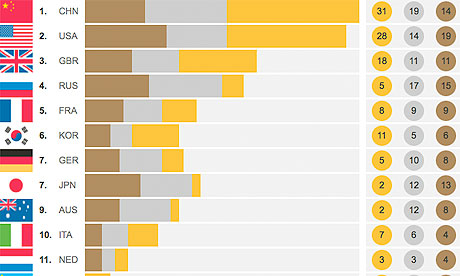
and the sight of this one calls for "Americans think they're so good but they actually suck" rants for days. I mean, what kind of Chinese person can live with being second best?
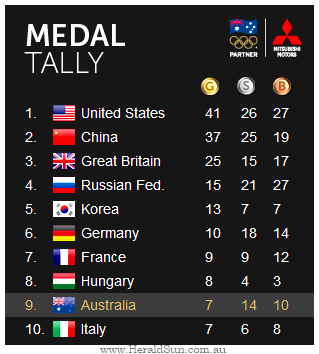
Sometimes it just seems outright ridiculous, but when I see that smiling Chinese athlete standing on the top podium, Chinese national anthem blasting and noble red flag rising on the screen, I understand.

Sunday, December 21, 2014

Aw Gaaaaleeeee

I don't know what all this fuss is about. I ain't but ten years old, but I got me some sense enough to tell when somethin's gone wrong. That's why I asked my Mama if that check coming the other morning. But my Mama she just tells me "you get your mind off money and eat your breakfast" (28).

I ain't got no idea why Mama says don't worry 'bout no money. She sends me to the other room to do my homework sometimes, and they thinking I'm focusing real hard, but I can hear Mama and Daddy fussing with Grandmama about that check. They worrying 'bout money all the time. I can't hear what they saying, but sometimes my Daddy's voice come up real loud and I can tell he's worried - real worried, ever since Grandmama told me about the new house she done got me for when I'm all grown.  Now I know my Daddy wouldn't never do nothing bad for me or Mama or aunt Beneatha and I wanna grow up to be just like him. And even though Mama can be a real pain making me get outta bed so early and such, I know I always be her "little old angry man" (30). But when they get on yelling like that I can't help feeling scared some. I thought when that check comes my Daddy will be acting fine again. Seems like things always fine when people are rich.

Well, turns out I was worrying for nothing. Today I saw a strange white man sitting in our little apartment. He was a nice looking white man, but something about him made me feel done uneasy. Good thing my Daddy was there right with me. My daddy he told that white man something special. He told him that we a family of proud, proud people. He told that white man that aunt Beneatha gone' be a doctor and we gone' be good neighbors and that I make "the sixth generation of our family in this country" (148). I ain't never felt so proud before as I was standing there next to my daddy in front of that white man. After my daddy done talking, that white man he scurried out of our apartment like a scared little mouse. Gaalee! Now we moving to our new house out in Clybourne - and it'll be all mine someday. I ain't ever figured out what all the fuss was about, but I knew my daddy wouldn't never let me down. Hot dog!
My photoshop skills

Sunday, December 14, 2014

The DIEmond as big as the ritz

Once upon a time, a 20th century Moses lived luxuriously on a mountain in complete isolation from society (save for his immediate family and a multitude of innocent prisoners and slaves.) Of course, this isn't just any mountain in the middle of nowhere; it's a mountain in the middle of nowhere composed of one solid diamond. Wait what?

"The Diamond as Big as the Ritz" is just one of Fitzgerald's short stories depicting the intricacies and dangers of wealth. In this highly imaginative tale, the members of the Washington family live a magical and seemingly flawless lives: they dwell in a "floating fairy-land...beyond human wish or dream", enjoy massive gardens and aquariums within their homes, and even roll out of bed (literally) each morning into warm warm bubble baths with "moving-picture" service. To say that pink elephants sent from heaven regularly roam their valleys would scarcely be a stretch.
However, beneath this utopialistic (that's not a word, is it) lifestyle lies a tradition of corruption and melancholy. In order to ensure that all of this wealth is kept solely to themselves, the Washingtons have "corrupted a whole department of the State survey" and even "had a river deflected" just to keep the diamond a secret. Braddock Washington even hides the abolition of slavery from his band of Negroes and locks up everyone who happens to come across the mountain in a dark and crowded pit. Realizing that being the only inhabitants of the middle of nowhere can be quite lonely, the Washingtons occasionally invite guests to their kingdom of diamonds to make their lives a little bit less emotionally lacking. But wait! Wouldn't these guests find out about the diamond and try to exploit the family's wealth after they leave? No problem - have fun with them today, and kill them tomorrow (a surefire way to ensure happiness, wise Washingtons.) The family is so inexperienced with true human emotion that when the youngest daughter, Kismine, hears her own name from John, she cannot help but inquire, "Did you say 'Kismine'? Or...[kiss me?]" One cannot blame her for her foolish rhetoric, however. What can we expect from someone who grew up with people who eternally trap themselves in social isolation?
Moral of the story: being wealthy is pretty depressing. Sometimes, it's better be a peasant with friends who aren't dead.

Sunday, November 30, 2014

Relationship Advice for Gatsby

Essential Question: What is the problem with romanticizing nostalgic memories of the past?

This is a question that Gatsby desperately needs to be answered. Captivated by the sweet memories of Daisy inside his head, Gatsby has created a romantic fantasy for himself that is simply unattainable in the real world. When he finally meets Daisy after adding to "the colossal vitality of his illusion" (Fitzgerald 95) for five long years, he is dismayed to realize that the real Daisy does not equate to the Daisy he devised in his dreams. However, what he doesn't realize is that this discrepancy is due not to Daisy's ineptitude, but to his own naiveté for romanticizing the past. "No amount of fire or freshness can challenge what a man will store up in his ghostly heart" (Fitzgerald 96).

Sadly, Gatsby is not the only one who faces this break with reality - people are letting their own minds break their own hearts all the time. A certain human once said to me: "Things change, and people change." He is right. As young adults especially, we cannot expect life as we know it to remain a constant, or for the people we'll know tomorrow to remain the people we know today. That being said, the root of the problem is that people are unaware of or simply unable to accept the change that is taking place around them.


When something of great sentimental value happens to us, it is forever stamped into our memory. It is the absolute peak of the relationship, and as that cherished moment floats around constantly in our heads, often times we do not realize that the relationship is actually going downhill outside of our ignorant, unrestricted brains. Every negative reality is cancelled out or justified by simply recollecting that peak moment of happiness, and we fool ourselves with the deadly hope that whatever happiness we experienced will, in fact, happen again. Unfortunately, when reality - that things have changed - finally hits us, the damage has already been done. We will never be able to recover those long hours wasted dreaming about, well, nothing.

So what is the problem? The problem is that by holding on too tightly to a memory from the past, we are not setting the stage for a better future, but closing the door to happier opportunities that we never thought possible. We cannot, like Gatsby, expect Daisy to leave her husband and marry himself instead, "just as if it were five years ago" (Fitzgerald 109). If we do, we are only setting ourselves up for disappointment and letting our own imaginations deceive us. Thus, I believe this calls for an Elsa moment.

Sunday, November 23, 2014

The Mirage of Marriage

One of the most common misconceptions about life involves the subject of marriage: a boy and a girl meet, fall deeply in love, and live happily ever after. As young teenage girls, I'm sure we've all spent a not-so-small fraction of our time piecing together the perfect future husband in our heads and fantasizing about our long-awaited wedding day to The One - the day that marks the beginning of a whole new era, the day that assures us we'll be loved forever, the day that our high school un-sweethearts will, once and for all, become mere figments of our imagination. Until we read the Great Gatsby, that is. (Actually the Bluest Eye already kind of ruined it but that's beside the point.)

After reading the first two chapters of Fitzgerald's prized novel, I am sure of exactly one thing: marriage is not all happiness and rainbows. In fact, marriage is more like storm clouds and tornadoes. In chapter one, it is evident that Tom and Daisy's marriage is far from loving - I could literally feel the tension between them jumping out from the page as I read. Between Daisy calling Tom "a great, big, hulking physical specimen" (Fitzgerald 12) and Tom's discussion about white superiority, it is clear that the couple cannot stand each other. A tone of tension and annoyance is set, with Daisy's "impersonal eyes absent of all desire" (12) and Tom "glancing at her impatiently" (12). The fact that Tom's mistress calls in the middle of dinner does not do anything for the awkwardness of the situation. Sorry Daisy, but looks like having such good looks doesn't work in your favor here.

Haha it's an egg...and they live at West Egg...get it
The second couple in the book seems equally miserable - Myrtle and George Wilson. After lying swiftly to her husband and running off to New York with Tom (and Nick), Myrtle cannot help but pour out all her heart's miseries concerning her marriage at the party, giving a "violent and obscene" (33) response to the mention of Wilson's name and calling her self "crazy" (35) for ever marrying him. As Myrtle's sister Catherine tells Nick, "'neither [Tom or Myrtle] can stand the person they're married to'" (33).

So is marriage really this depressing? Will we all make a horrible mistake by marrying one person, just to secretly fall in love with another? Dun dun dunnnnnnn...

Sunday, November 16, 2014

¡¿Punctuation?!

Punctuation, like the ornaments that adorn a Christmas tree the furniture that compliments a spacey room, is equally, if not more important than the writing itself. However, the manner in which punctuation is used should not be defined as a conventional set of rules; it should be up to the writer's judgment alone to employ punctuation in a way that most effectively expresses his/her ideas.

Just as Lewis Thomas states in his "Notes on Punctuation", "there are no precise rules about punctuation." He then proceeds to provide a careful (and deeply opinionated) analysis of each mark of punctuation: "The commas are the most useful...colons are a lot less attractive...exclamation points are the most irritating of all..." This is a prime example of the distinct uniqueness of punctuation for each individual. Just like Thomas, each of us has his/her own preferences and attitudes towards punctuation, and should apply it according to those preferences. Punctuation is also an element of great variety that is subject to change over time. As language and style of writing changes, punctuation evolves as well to reflect the change in culture. While forms of punctuation such as the pilcrow and the snark were at one time common grammatical markings, they have now fallen out of use - "punctuation comes and goes" (Punctuation, Social Media, and Evolving Rules of Communication). The reality is that there is no standard or traditional form of punctuation.

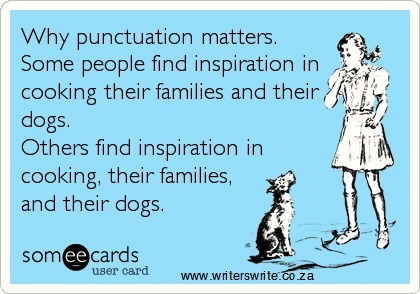
Of course, certain grammar rules must to be applied in order to ensure clarity and proper organization of thoughts. I'm sure JFK and Stalin are extremely thankful to the Oxford comma for preserving their non-stripper identity. In such situations, punctuation marks such as commas are instrumental in expressing a certain meaning, regardless of who is using it and the time period.
On the other hand, if punctuation is not necessary in order to convey meaning, adhering to a strict set of grammar rules can be extremely excessive and can greatly hinder the flow of a sentence. Consider this Facebook message from a kind and sweet human who shall remain unnamed.
Is it just me, or do those commas really have no business in this sentence? Obviously, removing them will not change the fact that I look pretty cute. In this case, the grammatically "correct" use of commas is like "tightening the leash" (Austen) and in all honesty should be "used sparingly" (Thomas).


Sunday, November 9, 2014

Soiled

"And now when I see her searching the garbage - for what? The thing we assassinated? I talk about how I did not plant the seeds too deeply, how it was the fault of the earth, the land, of our town. I even think now that the land of the entire country was hostile to marigolds that year. This soil is bad for certain kinds of flowers. Certain seeds it will not nurture, certain fruit it will not bear, and when the land kills of its own volition, we acquiesce and say the victim had no right to live. We are wrong, of course, but it doesn't matter. It's too late. At least on the edge of my town, among the garbage and the sunflowers of my town, it's much, much, much too late" (Morrison 206).

The last paragraph of The Bluest Eye provides the perfect tie-in with the second prologue of the novel with the recurring extended metaphor of Pecola and the marigold seeds. This extremely impactful passage, although written in simple and straightforward language, reveals a powerful underlying truth: the prevalence of racism and oppression is due not to the flaws of the blacks, but to the hostility of the world around them.
Society, with its multitude of prejudices, assumptions, and standards, represents the unyielding soil; the individuals who make it up constitute the seeds planted within. Just as some flowers are able to not only survive, but thrive, stripping away the land and nutrients for remaining seeds to flourish, the whites of society have established themselves at the top of the social hierarchy, leaving no freedom or probability for the colored to create lives for themselves. In the harsh reality of the real world, it is truly the survival of the fittest - the result is a thoroughly selective landscape that will inevitably force the weaker seeds to never sprout again. "Certain seeds [the land] will not nurture", and certain classes of individuals society will never receive.
When Claudia finally realizes that she did not plant the seeds too deeply, that the blacks are not faulty, not ugly, not inferior, it is too late. The world, just like the nature that adorns it, has already evolved to cultivate exclusively those whose roots have grasped the soil since the dawn of life.
My genius editing job